
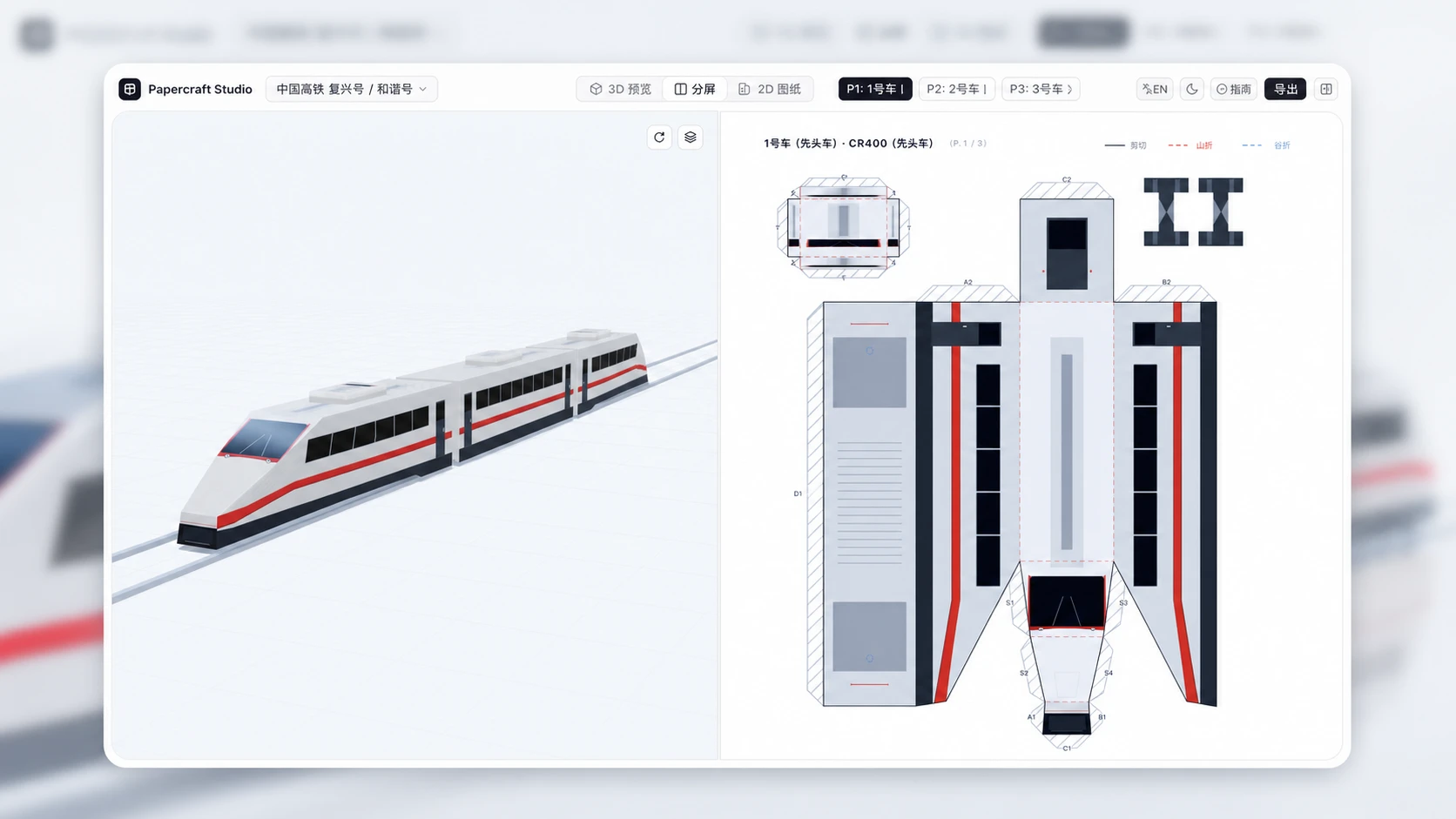
Papercraft Studio is a browser tool for designing train, road vehicle, and aircraft papercraft, customising liveries, and exporting unfolded sheets. Its model library, vehicle consists, 3D preview, livery editor, and A4 print layouts share one workspace.
Open the hosted build at /apps/papercraft/.
Current capabilities
Search and filter 24 models by name, category, or difficulty, then adjust supported consists in 3D. Basic and detailed variants remain available together. Road vehicles include a hatchback and open-bed pickup; aircraft include a touring propeller plane, twin-engine jet, rescue helicopter, and twin-float seaplane.
Start from presets compatible with the selected model, then edit colours, text, and uploaded artwork separately. Each model keeps its livery and consist draft while the current page session remains open.
3D, nets, and textures share the same faces and UVs. Complex surfaces can split into non-overlapping pieces, reconnect through numbered seams, and pack onto A4 sheets at their actual millimetre scale.
Export colour or blank PDFs with vector construction lines, seam numbers, and a 50 mm calibration ruler. Exchange model and livery resources through .papercraft files, or individual liveries through .papercraft-livery files.
Connections and printing
The articulated bus keeps both bodies facing the same way and connects them with two accordion sides, mounting flanges, and an underside flexible strap. PDFs for the new vehicles and aircraft include dedicated assembly notes; the plane’s wings and fin have integral mounting flanges. The 3D view shows unprinted paper backs on the open bed and wing undersides.
The hatchback and pickup have recessed wheel arches, a raised underframe, and four separate paper wheels glued to its mounting arms. The touring plane’s long two-blade propeller joins a separate hub. The jet has underwing engines and a display stand; the helicopter has skids and fixed rotors; struts connect the seaplane to two pontoons. On narrow screens, the toolbar places model, view, language, and export controls on separate rows.
Print at 100% / Actual size and check the 50 mm ruler before scoring mountain and valley folds and joining matching seams. Start bus joint trials with gentle turns of 15° each way. Paper thickness, glue layers, joint strength, and repeated motion still need physical testing. Paper wheels have no rotating axles, aircraft blades and rotors are fixed display parts, and the seaplane is not waterproof.
Current scope
- Models use planar paper facets, with complex noses approximated by folded surfaces. The search does not guarantee the fewest cuts; paper thickness, assembly order, and joint strength still need physical trials.
- The two detailed trains are designed around 18 cm car bodies and three A4 sheets; neither has completed a physical paper trial.
- The new models and bus joint have not completed physical paper assembly tests.
- Model drafts last only for the current page session and clear on reload. Resource packages omit the current consist and complete editing state, so they are not full project archives.
- Unfolding and pagination are currently tuned for standard A4 paper.
- Textures are generated with Canvas 2D; arbitrary external UV painting and baking are not supported.