
Notes
Oracles and Ragnarok

Every so often lately, I see the same two announcements: “The genius programmer is back!” and, not long after, “The genius programmer has fallen!” It is funny, but also remarkably honest. They attribute their “genius” to AI because they are, in fact, trying to make something. Whether the work is grand or trivial—or whether the idea is even theirs—can wait. When the AI allowance runs out, the progress bar stops. So does the genius.
Not everyone sees it that way. Plenty of people have spent so long away from the facts that reality is barely part of their job. AI accelerates many things, but the moment it hits the real world, friction slaps it in the face and makes it slow down. The catch is that not everyone ever has to hit the real world.
Over the long evolution of human society, the limits of human labor produced entire layers devoted to planning, explanation, and allocation. They are not useless, but neither are they necessarily meaningful. AI accelerates the workhorses; it also accelerates the machinery above them. The difference is that this machinery can run for a very long time without touching resistance. Inside it, people are often doing little more than imagining and wishing. AI can carry a wish a very long way. It may never reach a wall.
We keep hearing that execution no longer matters because AI can do it for you; ideas are what remain valuable. Not really. Most ideas are cheap. Many adults have less imagination than a child left alone for an afternoon. The problem was never whether someone could think of an idea. Most of the ultimate questions were asked in the distant past. The rare ability is turning an idea into something that can actually be executed.
It used to be rare. It still is.
AI lowers the cost of execution and replaces some of its details. It does not magically close the road from idea to reality.
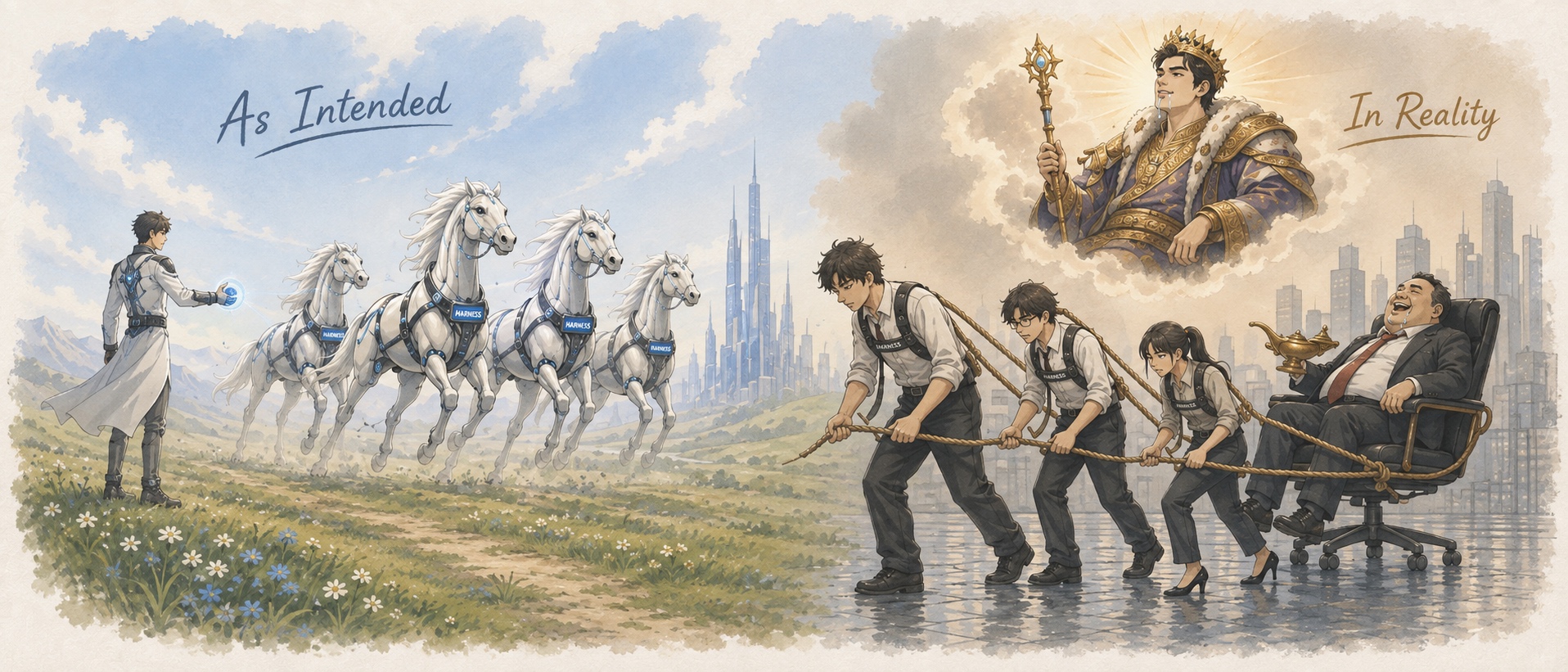
Some people never have to bear that friction. Execution is dirty work, after all. If nothing ships, blame the implementers for being incompetent. Blame them for not being AI-native enough. Blame the token budget. Blame investors for lacking vision. Anything but the possibility that the idea was unworkable, or that its author chose the wrong direction. Obviously, the author is the creator-god who saw the final future and will one day unite all creation.
There is no exaggeration in that sentence. This is a world I have watched up close: with AI’s help, some people’s delusions have slipped every leash. They sincerely and devoutly believe they are gods, and everyone around them is merely waiting to be converted.
By now, everyone in AI has heard the word harness past the point of nausea. Never mind whether it was a good metaphor, or how thoroughly it has been run into the ground. The original idea was at least sane: constrain AI with reality so it can move toward an actual goal.
Unfortunately, another scene is becoming just as common. People clutch an entirely unconstrained AI, spinning fantasies they cannot even put into coherent words, while demanding that someone else accelerate into the void around the clock. AI was supposed to be harnessed. It was supposed to make human work lighter. Instead, some people use it to mass-produce harnesses for other people, burning through their days and nights to drag the fantasy a little farther.
There is a line I have heard often in recent years: “A villain can scheme for days and still do less damage than a fool with a bright idea.” With AI, the fool no longer gets just one. Those “ideas” breed like maggots in a cesspit, brood after brood, spilling into the world.
The AI age has given us many more gods: code gods who ship a hundred to-do apps a day; research gods who produce a hundred new papers before dinner; creator gods who reinvent the ultimate future every morning. Oracles pour from the sky, ready to drown the old Atlantis.
And yet, by the middle of each week, the allowance runs out, and we are treated to a magnificent Ragnarok.
AI has indeed magnified your divine powers.
Just don’t forget to take your meds.